The Graduate
1967
Lauren Kicinski
Scroll for Snack Bar menu!
Story
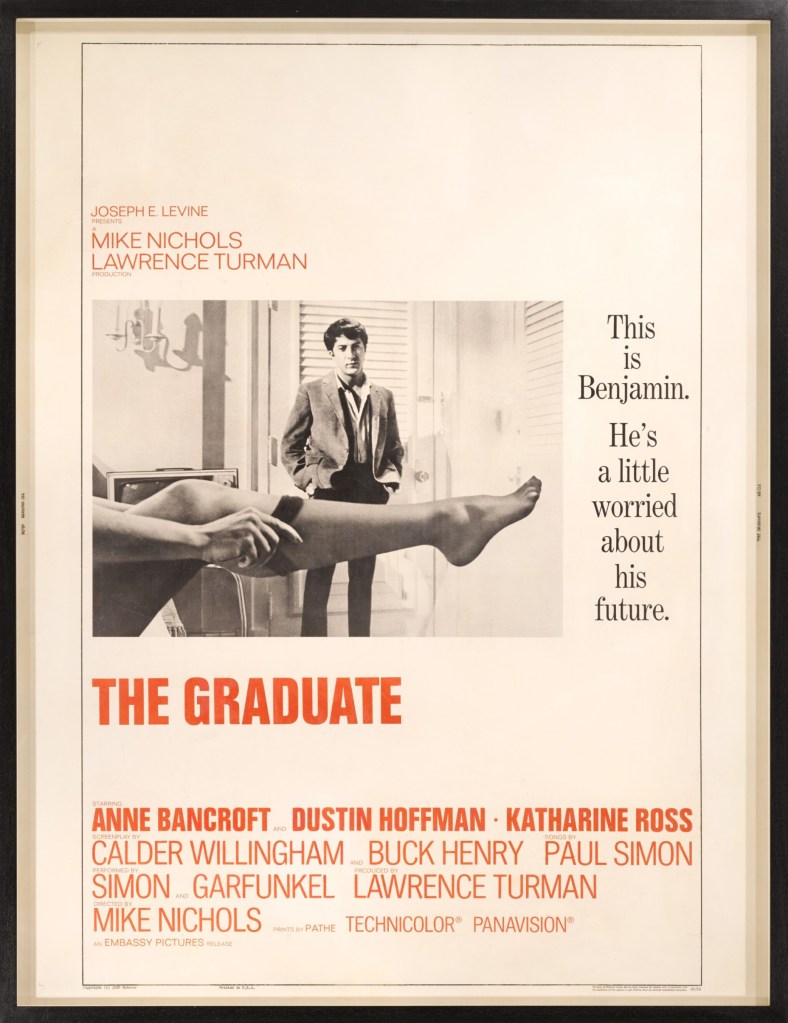
When Benjamin Braddock (Dustin Hoffman) comes home as a college grad, he’s stuck. He doesn’t know what he wants or what to do now, and the only thing people seem to care about is just that: what now? When he’s approached by Mrs. Robinson (Anne Bancroft), the wife of a family-friend, she isn’t asking about his future goals – she’s looking to sleep with him. A summertime affair begins, but complications arise when Ben starts to have feelings for Elaine (Katharine Ross), Mrs. Robinson’s daughter.
My Thoughts
In honor of graduating this year – congrats class of 2025! – it only felt right that I should watch The Graduate, especially since it’s been recommended a thousand times over. I won’t lie, however – it has not become my favorite film.
I say this not with complete disdain for the film, as I found some parts to be excruciatingly accurate and relatable, but definitely with some less-than-pleasant emotion behind it. Dare I say, I didn’t get it? It took some thought and a film analysis video essay on YouTube to help me better understand the story’s purpose, and even now, a few days after my watch, I feel that there is an open cavity still in need of filling.
Starting out, I would say I actually liked Ben’s character. Shy, awkward, unsure, inexperienced in life. Not completely unrelatable. Especially at a time of complete change. The questions he is bombarded with at his graduation party are the same questions I, too, have been slapped with this past year as a I exit the high school scene and enter the collegiate scene: “What are you going to do?” “What are you going to be?” In fact, we could go as far as to say that we have been conditioned to think about these questions even in childhood – think of those kindergarten “what do you want to be when you grow up?” activities. I’m five – leave me alone. The same feeling we see Ben experience in those first few minutes is the most perfect way of showing exactly what it feels like to end one (time consuming) era and be expected to jump right into the next. While I understand his father’s later concern for him not wanting to move on and join the real world, time for mourning (or equivalent feeling of your choice) this change should be allowed, too.
I think the story itself is also a testament to this “stuck” feeling. “Young man with no life experience is ‘seduced’ by married older woman.” Ben is currently at a fork in his life’s path; does he enter the work force, perhaps plastics, does he go to graduate school, or does he continue to not have an answer and just be? His lack of a solid idea of what he wants to do allows for something as crazy, for lack of a better term, as this to happen. He is impressionable, inexperienced, and all of a sudden someone experienced and looking for something to do with Ben appears. Not to say he allowed it to happen (he kinda did) but idle hands and all.
As the film progressed, I found that I identified with Ben less and less and felt that his actions became more derailed as his relationship with Mrs. Robinson fell off and he began to pursue Elaine. In the beginning, Ben is a pretty blank character. We don’t know much about him right off the bat, no one tells us about him, and we don’t learn much about him as a character during the story. What we do know is that he’s semi-depressed, unsure of what to do, and bored out of his mind. This character, however, bitters over the course of the movie, and becomes rather deranged. Yes, I’m going to be that guy; he stalks Elaine. Even before that, though, we see him lash out at Mrs. Robinson in their hotel room, recalling her alcoholic past and how he doesn’t even want to be there. When he is forced by his parents to take Elaine out, it’s an absolute shitshow. Honestly, I’m not even sure how they end up back in his car eating take-out, being all buddy-buddy. And never would this lead me to thinking Ben is in love with her. Again, his lack of direction creates unnecessary problems. I will say, though, that I’m glad we finally get to see Mrs. Robinson not just as the villain or antagonist of the story after Ben implies to Elaine that the older women he was seeing was, in fact, her mother. The soaking wet Mrs. Robinson, standing alone in the corner of the hall, as the camera zooms out from her face, shows that she, too, was as a player in this game and must face the consequences.
Something should be said about the absolute madness that is Ben’s plan to go to Berkley to “marry” Elaine. First of all, what? You had an affair with her mother and now want to be with the daughter you went out with once? Make that make sense. It isn’t romantic since she doesn’t know he’s there until the bus, and there are plenty of times that he just watches her before then. The whole apartment fiasco is another thing I wasn’t a fan of (either time, when she freaks out and when they kiss), but I’ll save you from the details. Ben’s going back and forth from Berkely to her house and then back to Berkely and then to Santa Barbara creates less for character growth and more questioning for me as the audience. Why was he so desperate to get Elaine when so many problems were caused because of her and her family? Did he actually love her, or was she another easy distraction that he could use to put off reality? I say this, however, I did find the wedding scene absolutely insane and ridiculously funny. Ben swinging around a cross to ward off the wedding guests, just moments after actually throwing hands with them, was pretty great. Though, just to note, if this and just a few times in the beginning produced a chuckle, I don’t think I would call the whole film a “comedy.”
As the film came to a close on the bus, I felt that I had lost the meaning to all of Ben’s work in retrieving Elaine and running off, if I even had an idea to start with. I’m sure that the lack of catharsis is intentional, to leave the audience feeling as uncertain as Ben and Elaine, as they now have to figure out what comes next. However, this just didn’t work for me. I’m not saying that I need a happy ending in everything I watch; in fact, I sometimes prefer films that are far from the “happily ever after.” In this case, though, some sort of resolution to all of the stuck-ness of Ben’s predicament would have been a step in the right direction, at least. Perhaps it’s just their faces falling that alludes to yet another lack of direction.
On a final note, I think I should mention again that it did take me a while to really understand this film and where it was coming from, in addition to what it was trying to say. A pioneer of the “quarter-life-crisis,” I think it really depends on where you are in life to appreciate the film’s reflection of the time between college and adulthood. Perhaps I couldn’t appreciate all that the film was saying because of where I am. Regardless, it’s a classic and I am glad I watched.
On the Snack Bar Menu
Click here for a snack that pairs perfectly with this one for your next movie night!
Lemon Glazed Sugar Cookies & Lemon Spritz Mocktail
If you are stuck on what snack to have for your watch party of The Graduate, much like Ben is stuck with his future, look no further than this summertime snack. Lemon is the citrus of the summer, so of course, we’re going all out with bright-flavored lemon-glazed sugar cookies, paired with a bright and bubbly lemon mocktail.
Ingredients
Sugar Cookies
- 1 cup (2 sticks) unsalted butter, cold and cubed
- 1 cup granulated sugar
- 1 egg
- 1 1/2 tsp vanilla extract
- 1/2 tsp almond extract
- 1.5 tsp baking powder
- 1/4 tsp salt
- 3 cups AP flour
Lemon Glaze
- 1 cup powdered sugar
- 2-3 tbsp fresh lemon juice
Mocktail
- 1/4 cup coconut water
- 1/2 cup of sparkling water
- 1 tbsp lemon juice
- 1/2 tbsp simple syrup
- lemon wedge to garnish
Directions
- Make your cookies: In the bowl of a stand mixer, cream together butter and sugar until smooth, light, and fluffy. Add in the egg, vanilla, almond, and baking powder and mix until incorporated. Slowly add in the flour until the cookie dough comes together.
- Chill your cookies: Scoop out and roll the cookies into 2 tbsp balls, or your prefered size, on floured parchment paper. Chill the cookies for 30 mins while preheating your oven to 350°F.
- Bake your cookies: Once cooled, bake the cookies for 11-13 minutes, until the edges are slightly golden brown.
- Make your glaze: In a medium bowl, add your powdered sugar and lemon juice, whisking until it comes together into a drizzle-able glaze. You may need to add more lemon juice as you go.
- Make your mocktail: In a glass, add the simple syrup and lemon juice. Top with ice, coconut water, and sparkling water. Gently stir.
- Garnish and Serve: Garnish the mocktail with your lemon wedge, glaze your cooled cookies, and go watch the movie!

